Commercial Office Cubicle Reupholstery Dubai is a practical solution for businesses looking to refresh their workspaces without the expense of replacing existing furniture. Commercial office cubicles experience constant use, making their upholstery susceptible to wear, stains, fading, and damage over time. Professional reupholstery restores the appearance of office partitions while improving employee comfort, extending furniture lifespan, and creating a cleaner, more modern, and professional working environment.
With Dubai’s competitive business environment, maintaining a modern and well-presented office is essential for leaving a positive impression on both clients and staff. Professional reupholstery services offer a wide range of fabric options, colors, and finishes that can be customized to match a company’s branding and interior design. Whether updating an aging office or refreshing a newly acquired workspace, commercial office cubicle reupholstery provides an efficient way to extend furniture lifespan while improving the overall aesthetics and functionality of the office environment.
Panel Fabric Replacement: Updating Office Colors Without New Furniture
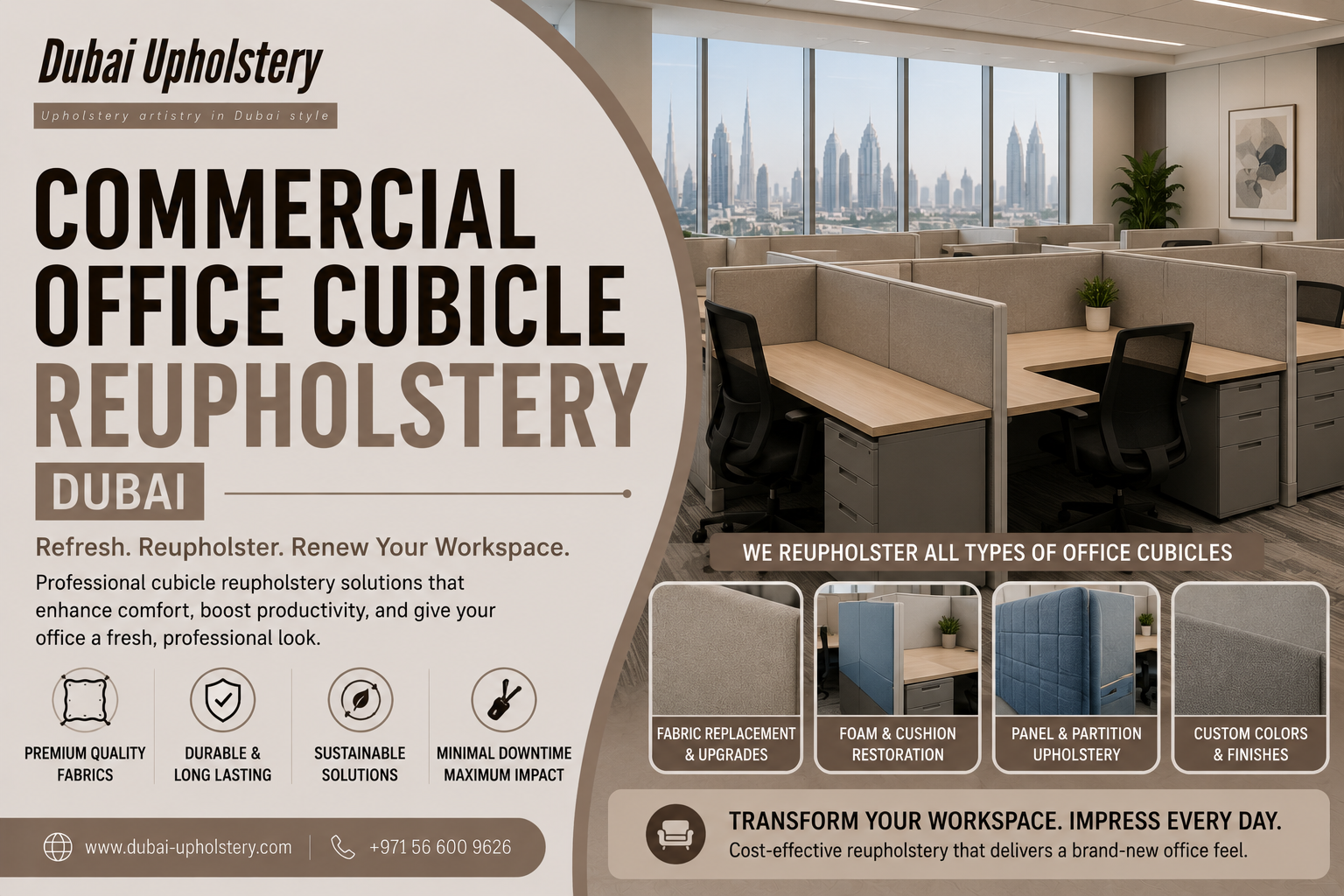
Panel fabric replacement is one of the fastest ways to refresh office interiors without replacing entire workstation systems. It focuses on updating visual identity while preserving existing structures.
Key advantages include:
- Lower cost than full furniture replacement
- Minimal disruption to operations
- Fast aesthetic transformation
- Compatibility with existing systems
Most modern office systems use removable fabric panels attached with clips or adhesive backing. These can be re-covered with new textiles to match updated branding or interior design schemes.
This approach is especially popular in corporate environments undergoing rebranding or office modernization.
Tackable Surface Re-lamination: Restoring Pinboard Function
Tackable panels in offices lose effectiveness over time due to surface wear, repeated pin insertion, and material breakdown. Re-lamination restores both function and appearance.
Key restoration steps include:
- Removing worn fabric layers
- Reapplying tackable backing materials
- Installing fresh fabric coverings
- Restoring pin retention performance
Proper re-lamination ensures that boards can securely hold pins without material tearing or loosening. It also improves the visual consistency of office partitions.
This is a cost-effective alternative to full panel replacement.
Edge Banding Repair: Preventing Fabric Peeling
Edge banding is a critical detail in office panel systems, preventing fabric from peeling or fraying along exposed borders.
Common issues include:
- Fabric lifting at corners
- Adhesive failure over time
- Frayed panel edges
- Visible structural wear
Repair methods involve reapplying adhesive bonding layers, reinforcing edges with binding tape, or replacing worn trim sections.
Proper edge sealing extends panel lifespan and maintains a clean, professional office appearance.
Acoustic Panel Replacement: Improving Sound Absorption
Acoustic panels play a major role in controlling noise in open-plan offices. Over time, their performance can degrade due to dust accumulation or material compression.
Replacement or upgrade benefits include:
- Improved speech privacy
- Reduced ambient noise
- Better workplace concentration
- Enhanced acoustic zoning
Modern acoustic materials use layered fiber structures or foam composites designed to absorb sound frequencies effectively. Replacing outdated panels can significantly improve workplace comfort without structural renovation.
Workstation Matching: Coordinating Cubicles Across Floors
Maintaining consistent workstation design across multiple floors is important for brand identity and organizational structure.
Key considerations include:
- Fabric color consistency
- Panel height alignment
- Material uniformity
- Modular system compatibility
Workstation matching ensures that employees across different departments experience a unified office environment. This is particularly important in large corporate offices and multi-floor commercial buildings.
Standardization also simplifies maintenance and future upgrades.
Fire-Rated Fabrics: Compliance for Commercial Buildings
Fire safety compliance is mandatory in most commercial office environments. Fire-rated fabrics are designed to meet strict regulatory standards.
Key features include:
- Flame-retardant treatment
- Low smoke emission properties
- Certified compliance documentation
- Self-extinguishing behavior
These fabrics are essential for meeting building codes and insurance requirements. In many cases, non-compliant materials cannot be installed in commercial spaces.
Fire-rated upholstery ensures both safety and legal compliance.
Antimicrobial Options for Shared Workstations
Shared workstations require materials that support hygiene and reduce microbial growth due to high user turnover.
Key technologies include:
- Antibacterial fabric coatings
- Silver-ion treatment layers
- Easy-clean surfaces
- Moisture-resistant materials
These treatments reduce bacteria buildup on high-contact surfaces such as armrests, desk dividers, and seating panels.
While not a substitute for cleaning, antimicrobial fabrics enhance overall workplace hygiene standards.
Modular System Expertise: Herman Miller, Steelcase, Haworth
Modular office systems require specialized knowledge for proper reupholstery and maintenance. Leading brands include:
- Herman Miller
- Steelcase
- Haworth
Each system uses unique panel connections, fabric attachment methods, and structural components. Understanding these systems is essential for accurate fabric replacement and panel repair.
Incorrect handling can damage modular integrity or void warranties, making expertise critical in commercial projects.
Bulk Refresh Programs: Phased Reupholstery During Occupancy
Large offices often require furniture upgrades without shutting down operations. Bulk refresh programs allow phased reupholstery while the workspace remains active.
Key strategies include:
- Floor-by-floor scheduling
- Night or weekend execution
- Modular furniture rotation
- Temporary workstation setups
This approach minimizes disruption while maintaining productivity. It is commonly used during rebranding, renovation, or corporate expansion projects.
Frequently Asked Questions
Can office cubicle panels be reupholstered?
Yes, most modular systems have removable fabric panels that can be replaced without changing the frame. This updates appearance at lower cost than new cubicles.
How often should office cubicles be reupholstered?
Every few years for high-use areas or during brand refreshes. Fabric degrades from UV, spills, and friction. Reupholstery extends panel life significantly.
What fabric is best for office cubicles?
Wool-nylon blends or high-performance polyester with acoustic properties. Both resist crushing and clean well, while providing sound absorption.
Can I change cubicle colors without replacing everything?
Yes, reupholstering panels in new colors and adding matching work surface laminates refreshes the look completely at fraction of replacement cost.
How long does cubicle reupholstery take?
Per panel: minutes to hours. For a full floor: weeks depending on panel count. Phased installation allows occupancy during work.
What is acoustic fabric and does it matter?
Acoustic fabric is permeable to sound waves, allowing the absorbent material behind it to work. Standard upholstery fabric reflects sound, reducing acoustic benefit.
Are fire ratings required for office cubicles?
Yes, UAE Civil Defense requires specific flame spread ratings for all commercial upholstery. Always verify fabric compliance before installation.
Can I reupholster only damaged cubicle panels?
Yes, matching existing fabric by dye lot is challenging but possible. Reupholstering all panels in a zone ensures uniform appearance.
What is the most durable cubicle fabric?
Solution-dyed nylon or polyester with high double-rub rating and stain treatment. Both resist fading, crushing, and cleaning chemicals.